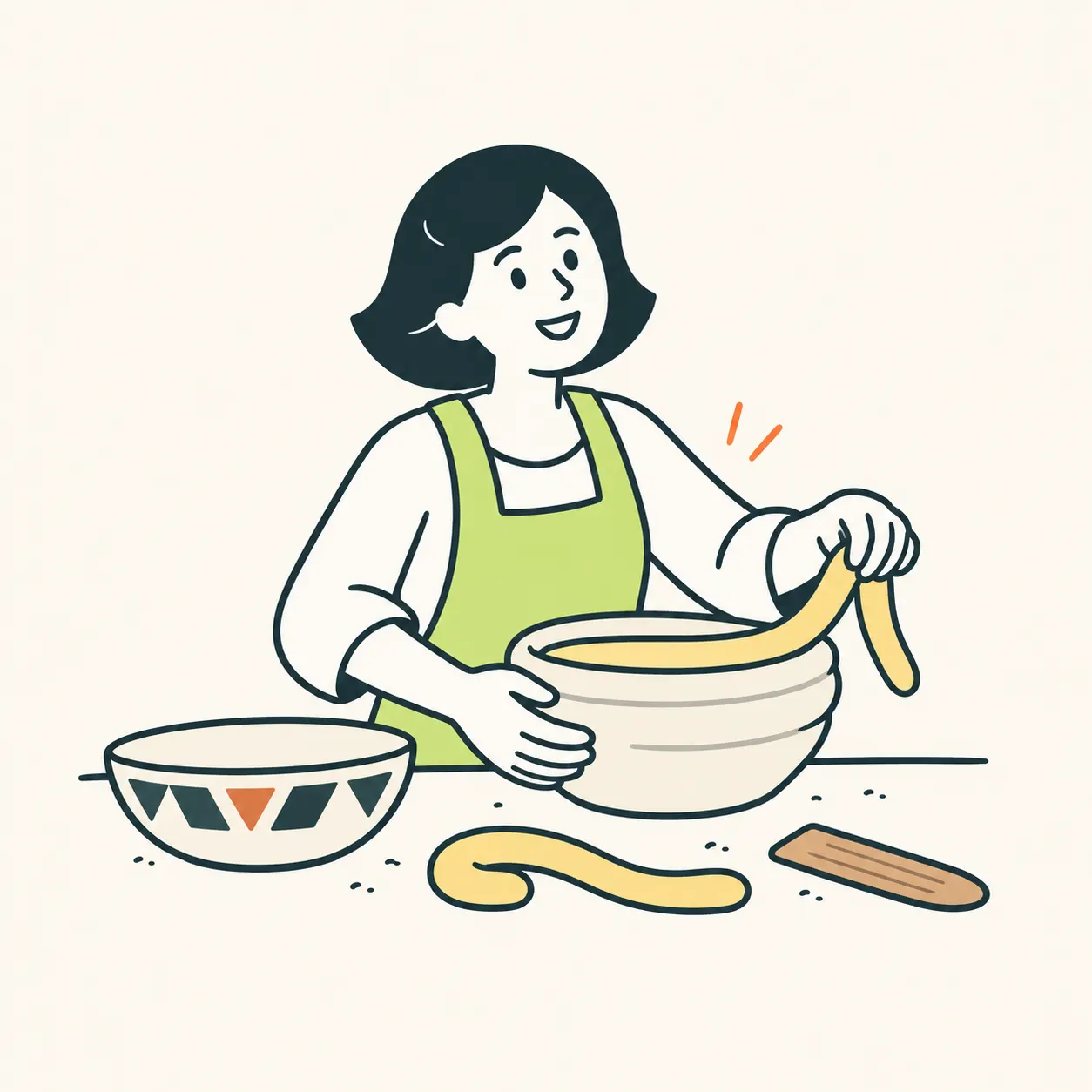
A finished bowl presents a continuous wall. How did that wall get there? In the pottery of women in Sejnane, northern Tunisia, one answer involves coils: ropes of clay stacked and joined together. The Tunisian National Heritage Institute describes this technique within a body of knowledge covering materials, shaping, drying, firing and decoration. An object is more than a drawing made solid; it carries the result of a sequence of practical decisions. [2]
The institute’s inventory explains that, after forming a base, the potter builds the walls by adding coils and smoothing them together. Support from inside and work on the surface help create a continuous form. There is no need to imagine a vessel carved from a block or a hidden electric wheel: the principle described here is building through additions. Our reading stays with that central idea, rather than presenting a short explanation as a pottery course. [2]
The nomination text reproduced by the institute includes household utensils, dolls and animal figures; geometric decoration is connected with regional textile patterns and traditional tattoos. It also describes earth and plant materials used for colouring. This does not imply that every triangle has one secret meaning. An ornamental resemblance cannot justify inventing a dictionary of symbols. Names, practices and attribution deserve more care than a general label such as “exotic”, applied by an outside observer. [1]
The inventory documents learning through family and neighbourhood relationships, alongside organised training. UNESCO’s record for a 2017 documentary also highlights the potters’ capacity to adapt production to new demand. Tradition and change are therefore not necessarily mutually exclusive categories. Our editorial interpretation is that preserving a skill may include using it in different circumstances, without giving us the authority to decide from outside which choices should count as authentic. [2][3]
As an editorial exercise, look at a bowl at home and try describing it with verbs instead of adjectives: prepare, add, join, smooth, dry. We are not attributing that object to Sejnane’s technique; its origins would still need checking. We are changing the question. Instead of stopping at “beautiful” or “traditional”, ask which knowledge and which people are needed to produce a form that initially looks straightforward and seems to require no explanation. [2]
The UNESCO inscription dates to 2018, as the Tunisian institute records. It is not today’s announcement or proof that every economic difficulty has been resolved. Our image has an explicit limit too: it is an editorial interpretation of coil building, using the newspaper’s colours and an invented figure. It does not depict an identifiable artisan or a certified object. Learning about the practice begins with the descriptions of those who document and maintain it. [1]
Take this with youEditorial prompt: when looking at a handmade object, first ask how it comes into being and who makes it, then how it looks.
One idea, in simple words
In Sejnane, Tunisia, women potters build clay vessels using coils. These are ropes of clay: after preparing a base, the potter stacks and joins them to make the walls grow. She then smooths the surface. Adding a pretty pattern is not enough; making pottery also requires knowledge of materials, drying and firing. These skills are learned through community relationships and organised courses. UNESCO recognition came in 2018, rather than today. As an editorial example, look at a bowl at home and imagine the actions needed to build it. This does not mean it was made in Sejnane. Our illustration presents a working idea with an invented person; it is not a photograph of an actual artisan. [2][1]
A little discovery to keep
What did you discover?
Read the sources (3)
- Les savoir-faire liés à la poterie des femmes de Sejnane Institut national du patrimoine, Tunisie · accessed 19 Oct 2026
- Fiche d’inventaire n° 7/001 : Savoir-faire liés à la poterie modelée des femmes de Sejnane (informazioni inserite il 28 giugno 2016) Institut national du patrimoine, Tunisie · accessed 19 Oct 2026
- Les savoir-faire liés à la poterie des femmes de Sejnane — notice du documentaire de 2017 UNESCO Multimedia Archives · accessed 19 Oct 2026
Original writing and illustration made with AI assistance. Our editorial method
More in Cultures & peoples