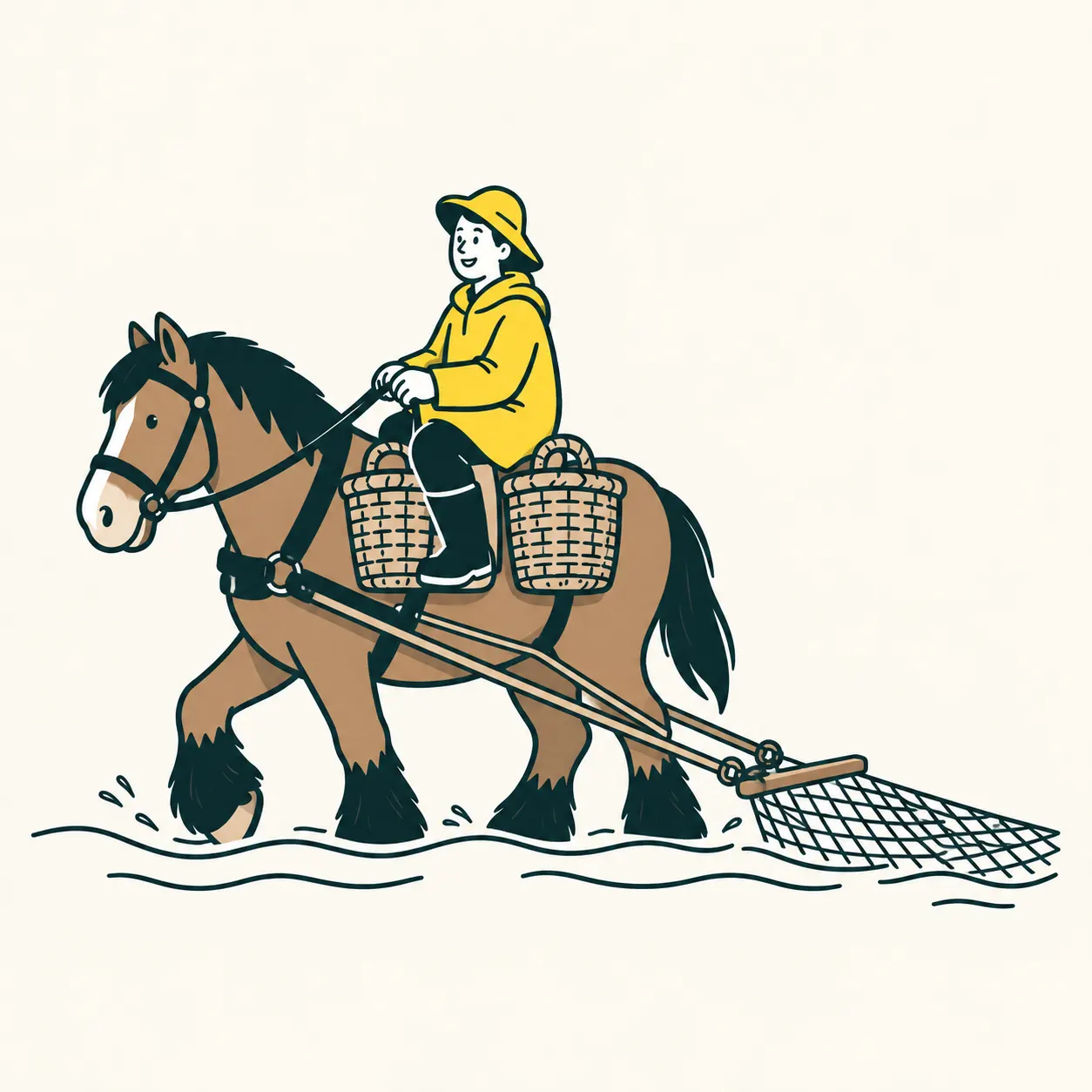
A horse walks through the water with a person guiding it: judging only by the silhouette, we might imagine a seaside ride. In Oostduinkerke, on Belgium’s coast, it may instead be shrimp fishing. NAVIGO, the national fisheries museum, describes this local practice using Brabant draft horses. It is not a portrait of every Belgian resident or a general custom shared by all coasts. It is knowledge connected to a place, the people who practise it and sea conditions that cannot be controlled by a photographer’s schedule. [1][2]
The horse’s role is to pull a funnel-shaped net while moving parallel to the coast in shallow water. NAVIGO describes two boards holding the net open and a chain dragged across the sand: its vibrations make shrimp jump into the net. Fishing takes place around low tide. The horse does not choose or catch individual animals, and the net is not carried in the air like a shopping bag. Each piece of equipment contributes to a system that is pulled through the water. [2]
At intervals, the fisher returns to the beach to empty and sift the catch, which is collected in baskets carried on either side of the horse. The museum emphasises knowledge of tides, currents, the seabed and the animal’s behaviour. Trust between horse and person is not a romantic detail added afterwards; it forms part of the work described by practitioners. A photograph can show baskets and boots, but not all the experience needed to read a day at sea or recognise when a condition changes. [2]
How is a skill like this passed on? NAVIGO’s training page describes a two-year course with an accredited shrimp fisher, followed by theoretical and practical tests. The theory component involves the museum; a jury assesses the practical work. The point is not to turn this feature into instructions for entering the water. It is to recognise that a tradition requires learning, observation and assessment. Visible tools are only part of what passes from one person to another when a craft continues. [3]
NAVIGO records the practice’s inscription on UNESCO’s intangible cultural heritage list in 2013. That year concerns the recognition, rather than the birth of the craft or a new announcement in 2026. As an editorial exercise, imagine describing the scene without the word picturesque: a net, a tide, an animal and shared skills remain. That already makes an interesting story. Recognising a living culture means noticing the work, its rhythms and the people learning it, rather than turning practitioners into motionless figures in a postcard. [1][2]
Take this with youWhen looking at a photographed tradition, ask about the knowledge outside the frame: who teaches it, which conditions matter and how learning is assessed.
One idea, in simple words
In Oostduinkerke, Belgium, some people catch shrimp using draft horses. A horse walks through shallow water and pulls a net, moving parallel to the coast. A chain dragged over the sand produces vibrations that make shrimp jump into the net. Fishing follows the timing of low tide. On the beach, the catch is sorted and gathered into baskets. This work requires knowledge of the sea, the seabed and the horse. The NAVIGO museum describes two years of training with an experienced fisher and final tests. Imagine a photograph of the scene: you see a horse and a net, but not all the knowledge needed. In 2013, this practice received UNESCO recognition as intangible cultural heritage. [1][2][3]
A little discovery to keep
What did you discover?
Read the sources (3)
- Shrimp fishers on horseback NAVIGO National Fisheries Museum · accessed 28 Oct 2026
- The craft of fishing on horseback NAVIGO National Fisheries Museum · accessed 28 Oct 2026
- The recruitment process: how do you become a shrimp fisher? NAVIGO National Fisheries Museum · accessed 28 Oct 2026
Original writing and illustration made with AI assistance. Our editorial method
More in Cultures & peoples