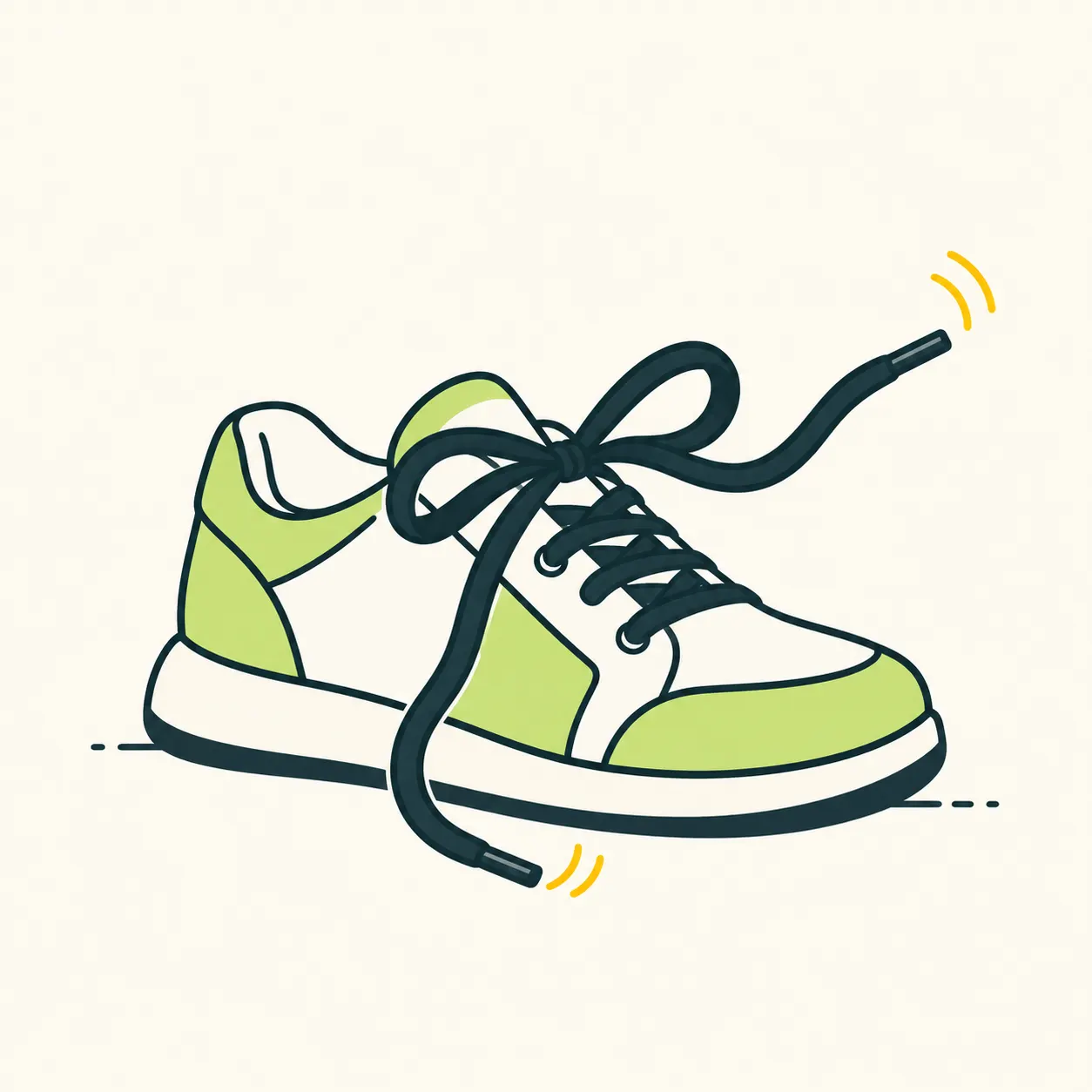
You tied your shoes, went outside and soon a lace was trailing on the ground. Who pulled it? The question seems too small for a laboratory until we watch the bow in slow motion. In 2017, a mechanical engineering team at the University of California, Berkeley studied precisely this failure. The detail worth following is the difference between the knot’s centre, its two loops and the two ends left free to move. [2]
The central finding is a combination, rather than a single culprit. Repeated impacts of the shoe against the ground deform and loosen the knot; movement of the laces can then pull the free ends through its centre. The study connects failure to the interaction of impact and inertia, the resistance of bodies to changes in their motion. There is no hidden hand: different parts of the same everyday movement are acting together. [1]
The researchers began with slow-motion footage of a runner on a treadmill and developed controlled tests using a pendulum striking a surface. This second stage let them change conditions and compare results. They were looking beyond an already untied knot to the process that produced it. In some sequences, limited initial loosening was followed by rapid acceleration. That gives us an unexpected connection: something we notice suddenly may have been developing in a less visible way beforehand. [1]
For an editorial example, imagine two photographs of one shoe, taken before and after a walk. They show that something changed, but cannot by themselves explain when it began. Video adds the order of events; a controlled experiment can test an explanation. This distinction is not evidence about every individual lace. It helps explain why observation and experimental comparison answer different questions, even when the object in front of us feels entirely familiar. [1]
The paper also compares two common bow versions, based on crossings oriented differently, and finds different tendencies to fail. It does not provide a formula predicting the number of steps after which every shoe will come untied. The authors explicitly say they did not investigate the effects of lace material and surface finish. A knot may also withstand many cycles: the mechanism does not mean that every bow must open during every single walk. [1][2]
The invitation is to observe before simply blaming our absent-mindedness. With a shoe resting still, identify the centre, loops and free ends. When watching the research team’s footage, distinguish loosening from the moment an end slips through. There is no need to walk with loose shoes to make the discovery. Our image is an editorial vignette of the problem, rather than an experimental sequence or a diagram teaching a knot guaranteed never to fail. [2]
Take this with youEditorial prompt: examine a bow on a stationary shoe and identify which parts can move without moving the whole shoe.
One idea, in simple words
Why can a bow come undone while you walk? A study published in 2017 watched shoelaces in slow motion and used controlled tests. Impacts of the shoe against the ground can loosen the knot. Meanwhile, the free ends swing and can pull the lace through its centre. These two effects work together. Inertia means a body’s resistance to changes in its motion. As an editorial example, look at a stationary shoe and identify the knot’s centre, two loops and free ends. You do not need to walk with untied shoes. The result does not say every knot always opens: conditions matter, and the study did not explore every possible lace material or finish. [1]
A little discovery to keep
What did you discover?
Read the sources (2)
- The roles of impact and inertia in the failure of a shoelace knot Daily-Diamond, Gregg and O’Reilly · Proceedings of the Royal Society A / UC eScholarship · accessed 19 Oct 2026
- Shoe-string theory: Science shows why shoelaces come untied University of California, Berkeley · accessed 19 Oct 2026
Original writing and illustration made with AI assistance. Our editorial method
More in Curiosities