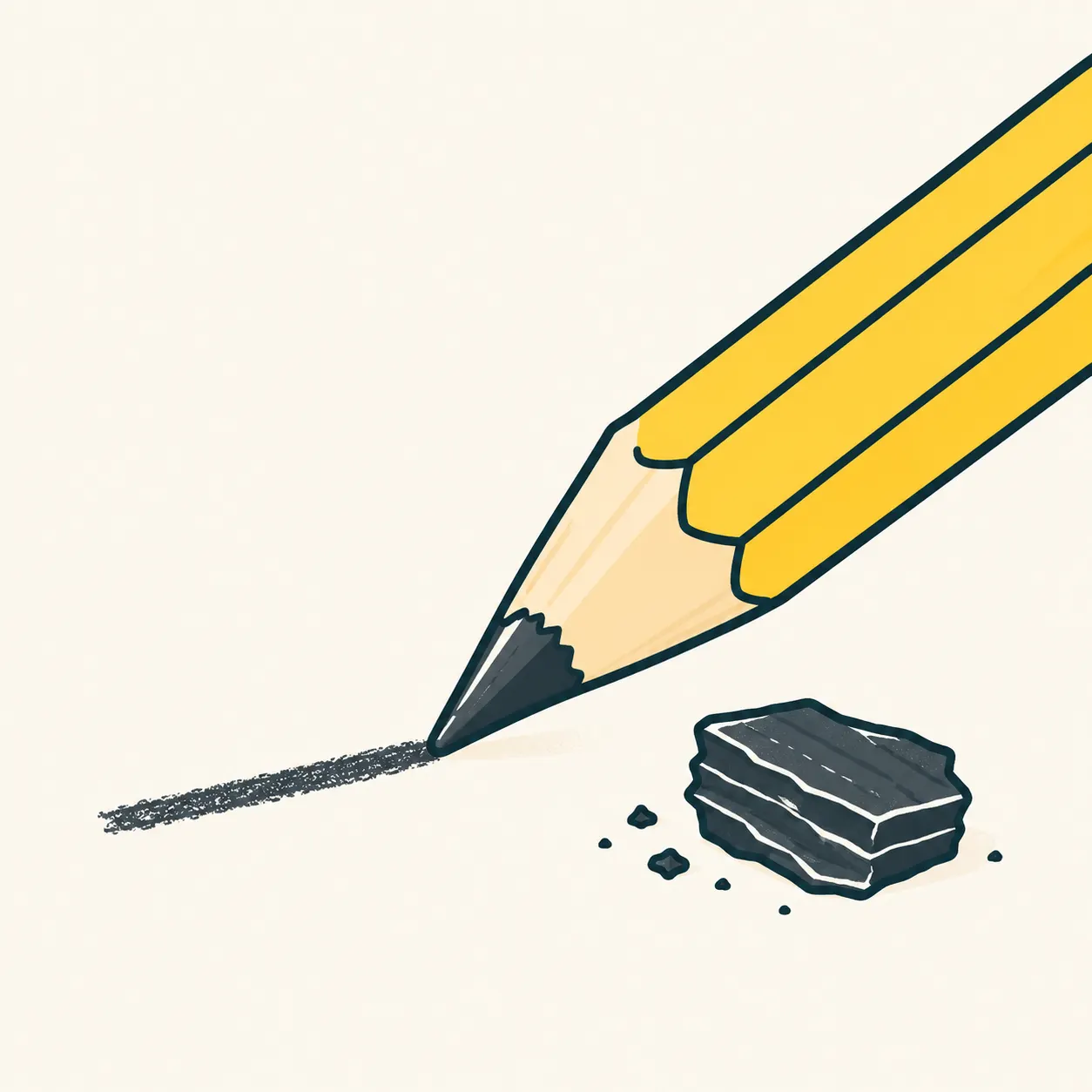
You move a pencil across paper and a line appears. You have not opened an ink tap: some of the tip has transferred onto the page. The explanation begins with a familiar object and reaches a structure invisible to the naked eye. Pencil cores contain graphite mixed with clay, explains the United States Department of Energy. Graphite is a form of carbon. The familiar English word lead, still used for a pencil core, therefore does not mean that a little cylinder of the metal lead sits inside your pencil. [1][2]
The crucial detail is the arrangement in layers. An MIT article describes graphite as many stacked sheets of graphene: thin layers can flake off under pressure, just as they do when someone writes with a pencil. A mark therefore depends on more than a colour chosen by a manufacturer; it also relies on how matter behaves. A stack of paper is our editorial comparison to help picture this. It does not reproduce the scale of atoms or all the forces that hold the material together. [2][1]
The unexpected connection leads to graphene. The University of Manchester describes it as a layer of carbon atoms arranged in a hexagonal pattern, just one atom thick. Graphite contains many such layers stacked together. In 2004 Andre Geim and Konstantin Novoselov isolated graphene through mechanical exfoliation using adhesive tape. Here, exfoliation means separating layers, rather than giving a sheet an unusually expensive beauty treatment. The same family of materials connects an ordinary action with an experiment in a laboratory. [3][1]
The Science Museum Group holds a dispenser and tape used in the Manchester experiment in 2004. It is a concrete object, less spectacular than one might expect from a story that led to the 2010 Nobel Prize in Physics. That does not mean a pencil and a piece of tape are enough to reproduce all the measurements, conditions and checks of the scientific work. The simple tool is part of the story; recognising and studying what has been obtained is another essential part. [4][3]
Here is an observation suggested by the editors: draw a pale patch and a darker one, changing the pressure without breaking the tip. You can compare visible marks, but cannot directly observe individual atoms. Not every line is an isolated graphene sample, and a sketch does not automatically become an electronic device. The small discovery is more precise: a property of the material makes a daily gesture possible. A pencil leaves a trace because some of its material can separate and settle onto the paper. [1][2]
Take this with youLook at your next pencil mark as transferred material: an invitation to notice layers without mistaking the page for a laboratory.
One idea, in simple words
When you write with a pencil, some of its core leaves a mark on the paper. The core contains graphite and clay. Graphite is carbon arranged in many layers. Pressure can make thin layers flake off, transferring material to the page. A single layer of carbon, one atom thick, is called graphene. In 2004 two researchers isolated it using adhesive tape. This does not mean every drawing is a sample of pure graphene. Imagine a stack of sheets that can separate: it is only a comparison to help explain layers. Drawing two lines with different pressure lets you observe the marks. You cannot see the individual atoms with your eyes. [1][2][3]
A little discovery to keep
What did you discover?
Read the sources (4)
- Graphene: Amazing Material Found Thanks to Scotch Tape and Persistent Science U.S. Department of Energy, Office of Science · accessed 28 Oct 2026
- MIT physicists discover a new type of superconductor that is also a magnet MIT News · accessed 28 Oct 2026
- History of graphene The University of Manchester · accessed 28 Oct 2026
- Tape dispenser and Scotch sticky tape — object 2011.25.3 Science Museum Group · accessed 28 Oct 2026
Original writing and illustration made with AI assistance. Our editorial method
More in Curiosities