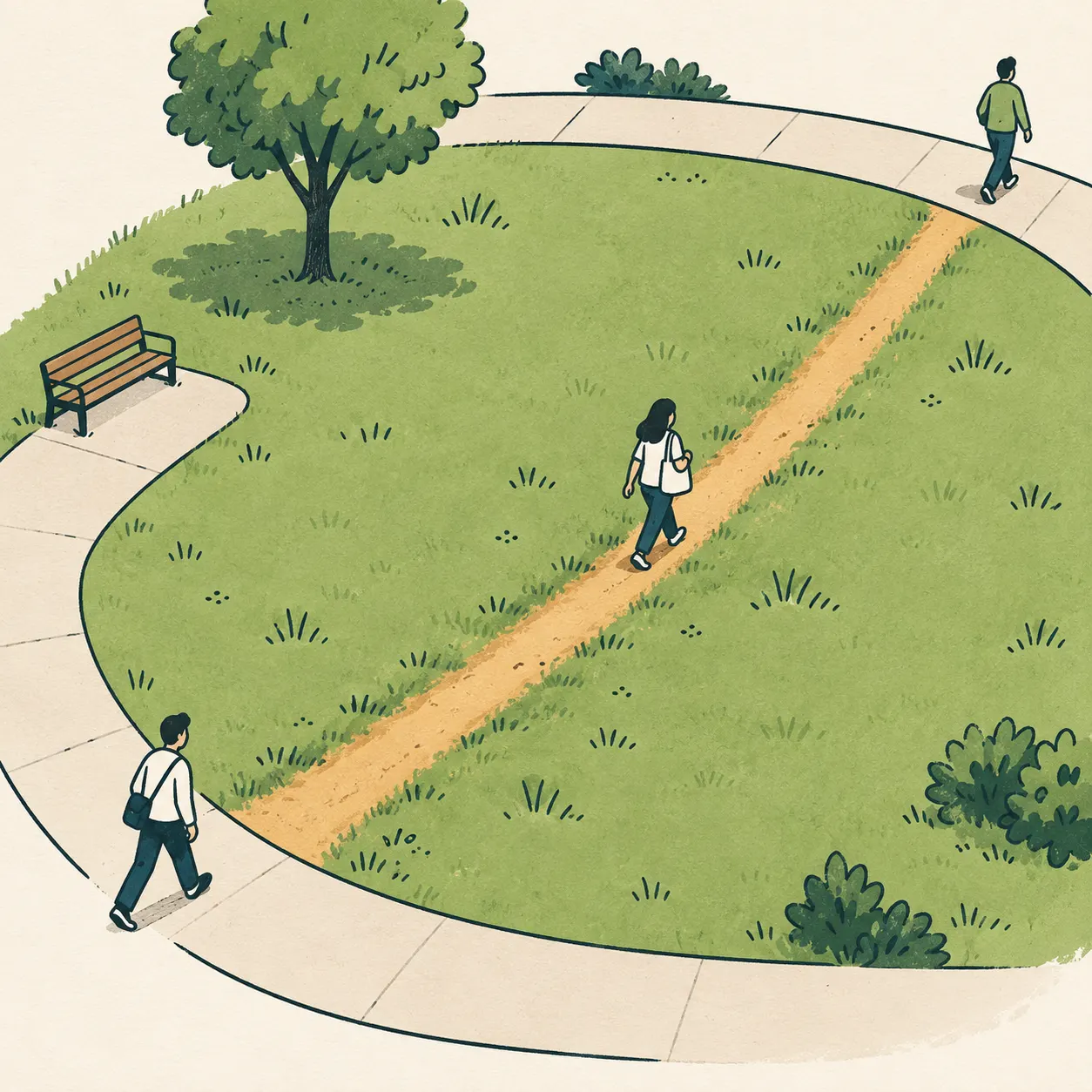
Imagine a park: the path bends around a lawn, while a strip of bare ground cuts across the corner towards the gate. This is our editorial scenario for exploring the idea. The plan shows a neat curve; the ground also carries another line. Who drew the second one? Perhaps nobody meant to draw anything: someone simply wanted to reach the other side. [1]
Don Norman includes these informal footpaths, known as desire lines, among social signifiers: traces that can guide us without an intended message. In our park, the strip seems to suggest that someone has already passed that way. Its authors may have left long before we begin to read it. [1]
The model developed by Helbing, Keltsch and Molnár links walking with the ground: footsteps alter the surface; the resulting trail attracts further use, which reinforces it. In our scenario, the next person encounters a slightly different lawn from the first. There is already a small suggestion on the ground. Each passage can add something to what the following person will find. [2]
Let us give two of those journeys a human shape. One person comes through the gate towards the bench; another arrives from the opposite corner. If, in our example, both use the final stretch beside the seat, that piece of path contains two different journeys. The lawn can retain the point where their choices met, even if they passed hours apart. [2]
Let us return to the curve on the plan and the strip across the lawn. For us, the discovery is a simple relationship: we use a space and can also change the clues it offers. The plan proposes how to cross it; use leaves a second description. Looking at both versions makes the park more interesting: we can ask where they agree and where people have started to draw a variation. [2]
A trace does not certify the best route for everyone. The study does not establish a universal solution. In our park, turning that line into a proper path would still leave practical questions: could someone use the surface with a pushchair or a wheelchair? Where does the route end? Its presence can open an enquiry into the design; it cannot settle that enquiry by itself. [2]
Your next walk could become a small reading of the landscape: a worn edge, a fork, two paths joining. Try looking for a trace of the difference between the space as drawn and the space as used. You do not need to discover the first walker’s name to find this collective writing interesting. The lawn has not prepared a presentation; curiosity can start without one. [1][2]
Take this with youObserve a route from the existing path. Note one visible fact and one unanswered question. You do not need to make a new trace to learn to read one.
One idea, in simple words
Imagine the park in our example: the path goes around the lawn, but a strip of bare ground cuts across the corner. Nobody has put up an arrow. Yet that line can suggest that other people have passed that way. Don Norman calls clues left without an intended message social signifiers. [1]
Footsteps mark the ground, attracting further use. In our park, the next person already has a clue. This is the loop in the model, a simplified description. It does not mean that every trace is the best route for everyone. Look from the existing path at where a line starts, where it ends and whether it joins another. You may discover a difference between the park as designed and as used. [2]
A little discovery to keep
What did you discover?
Read the sources (2)
- Signifiers, not affordances Don Norman · JND.org · ACM Interactions · accessed 15 Oct 2026
- Modelling the Evolution of Human Trail Systems · testo completo degli autori Dirk Helbing, Joachim Keltsch e Péter Molnár · arXiv; Nature 388, 47–50 (1997) · accessed 15 Oct 2026
Original writing and illustration made with AI assistance. Our editorial method
More in Curiosities