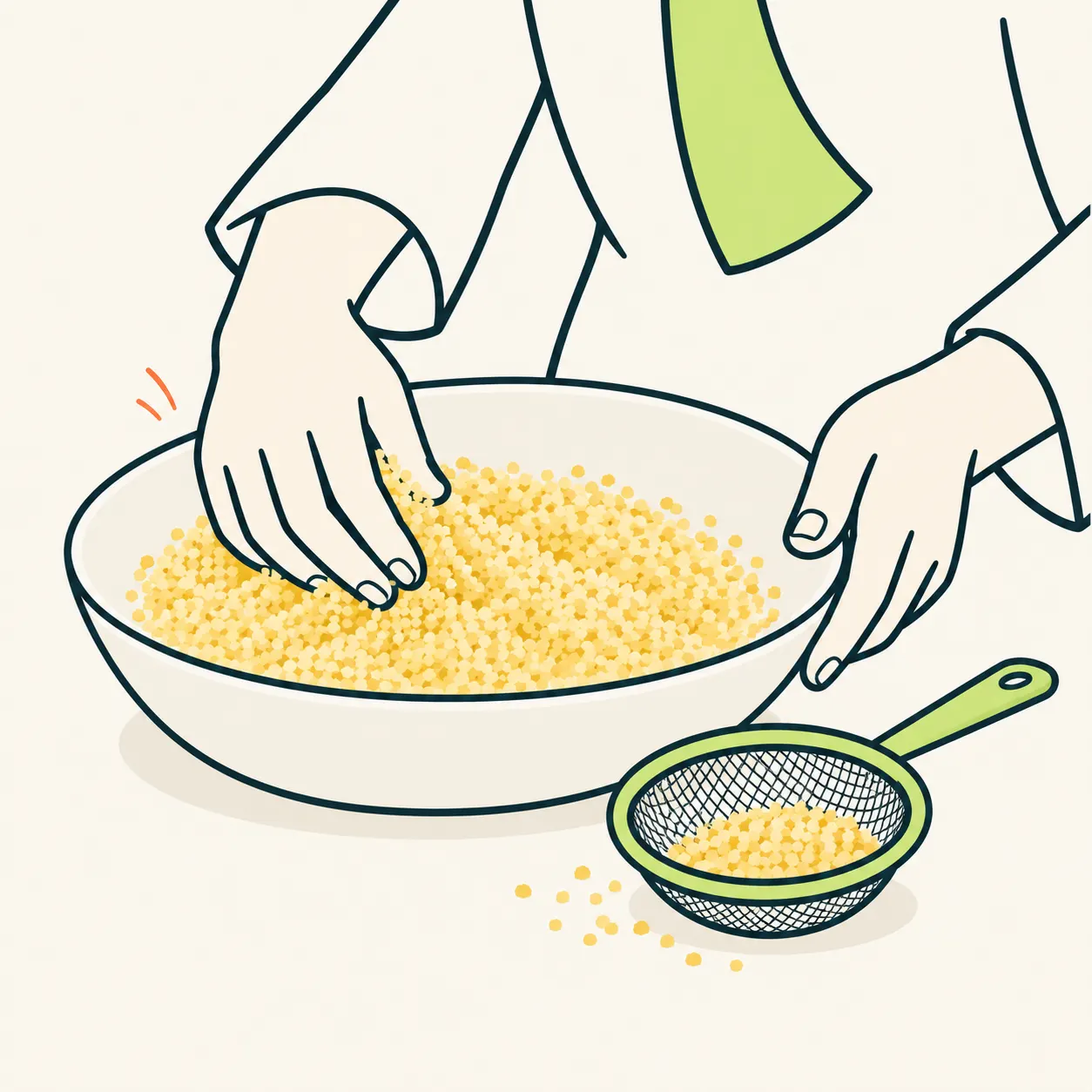
Looking at a bowl of couscous, we might imagine a harvest of tiny seeds. In the durum-wheat semolina couscous described by the Academy of Nutrition and Dietetics, however, the grains are made. Semolina comes from milling wheat; moisture and movement bring particles together. The central discovery is simple and changes how we see the dish: the size before our eyes is also the result of preparation knowledge, rather than only a property of a plant. [1]
The traditional process described by the source involves working moistened semolina, forming grains and separating them with sieves, followed by steaming and drying according to the product being prepared. Adding water to flour does not make every resulting lump couscous. The movement must produce a suitable structure. In our editorial example, a sieve is more than a picturesque accessory: it separates sizes and helps reveal that texture is being constructed during the work. [1][2]
A study presented at the 2016 European Young Cereal Scientists and Technologists Workshop examines the rolling stage in industrial production. Its abstract distinguishes agglomeration, rolling, cooking and drying, and investigates a pilot device with sorting grids. We do not automatically transfer the results from that equipment to every kitchen. The useful contribution here is seeing that rounding and classifying grains are specific operations, which can also be studied as processing questions. [2]
The dish, however, is more than its structure. In December 2020, UNESCO inscribed the knowledge and practices associated with producing and consuming couscous through a joint nomination by Algeria, Mauritania, Morocco and Tunisia. This is historical recognition, not news from today. The description includes skills, utensils and transmission through observation and participation: food connects agricultural work, transformation and shared life, extending well beyond the finished bowl in front of us. [3]
The same source emphasises local and family variations. A shared tradition does not impose one recipe or assign an identical experience to every person in the four countries. For our reading, it helps to distinguish the grain, the techniques that make it and the meal in which it is served. These are connected but different levels. A technical description cannot by itself explain every social occasion, ingredient or family memory. [3]
The next time you open a packet, read its ingredients and specific instructions before applying a generic recipe: processing and sizes can differ. This reading does not offer a nutritional ranking; it invites an observation of form. As a small editorial exercise, compare something that looks like a whole kernel with something milled and formed again. Asking how a grain is made brings attention back to work that the finished product tends to hide. [1][2]
Take this with youLook at the grain before the sauce: which processing steps disappear from view when we only look at the meal already served?
One idea, in simple words
Semolina couscous grains are not harvested from a plant already shaped as they appear on our plate. They are made by working semolina, which comes from milling durum wheat. Water and movement help its small particles join together. Sieves separate grains of different sizes. The process described by the sources also includes steaming and drying. Imagine one small grain: its shape therefore tells us about people’s work and tools. Couscous practices received UNESCO recognition in 2020 through a joint nomination by Algeria, Mauritania, Morocco and Tunisia. That does not mean there is one recipe for everyone. Families and places keep different versions. This reading concerns semolina couscous. With a packaged product, always check the ingredients and its instructions instead of assuming that every kind is prepared in the same way. [1][2][3]
A little discovery to keep
What did you discover?
Read the sources (3)
- All About Couscous Academy of Nutrition and Dietetics · Michele Redmond and Kerry Neville · accessed 23 Oct 2026
- 15th EYCSTW: Effect of the rolling step on the couscous grains properties, Bettina Bellocq et al., programme p. 32 (2016) Cereals & Grains Association · Montpellier SupAgro / INRA research · accessed 23 Oct 2026
- UNESCO’s inscription of couscous traditions, an example of international cultural cooperation UNESCO · accessed 23 Oct 2026
Original writing and illustration made with AI assistance. Our editorial method
More in Food