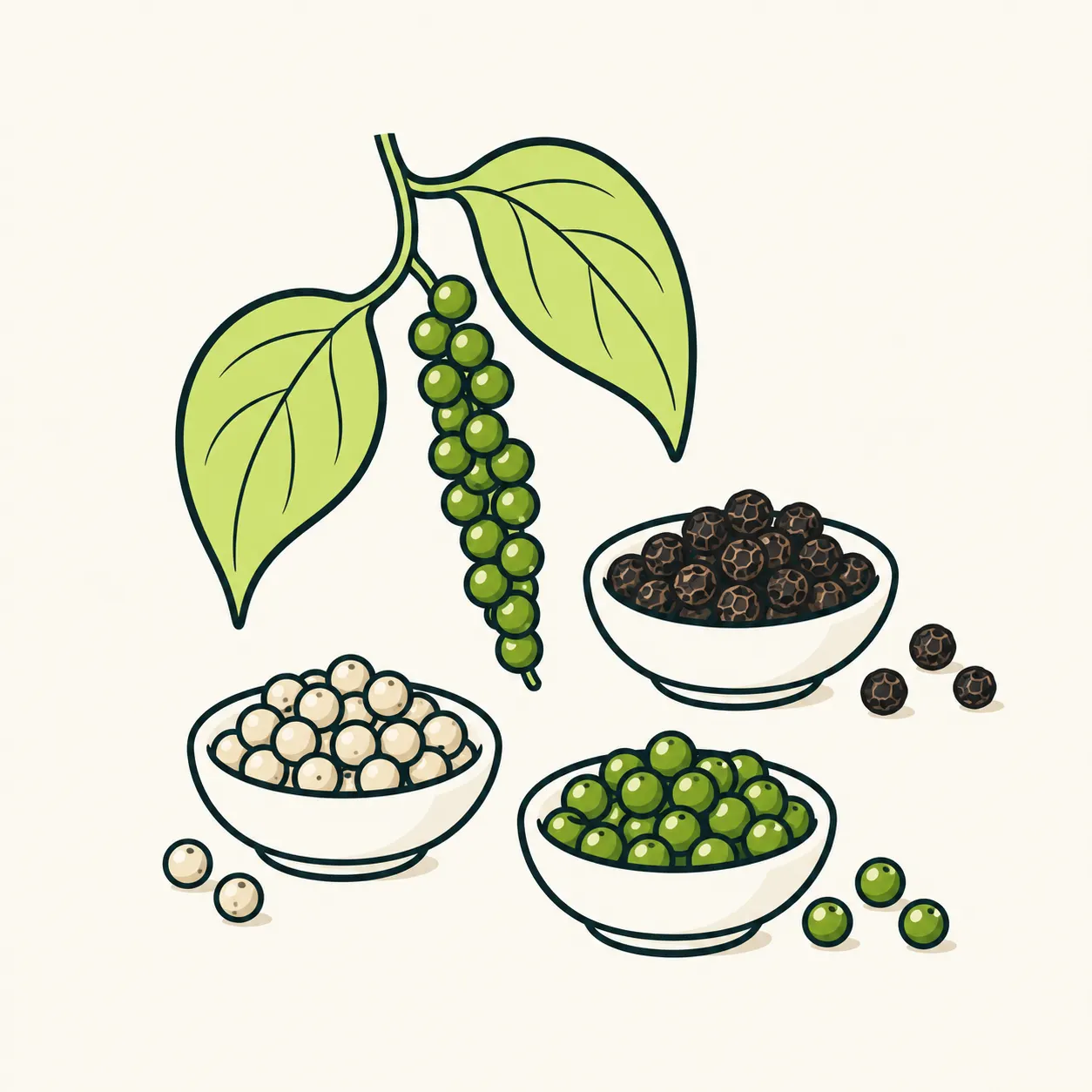
Two pepper mills stand on the table. One holds dark, wrinkled peppercorns; the other contains pale ones. A first guess might be that they come from different species. For black and white pepper, however, the plant is the same: Piper nigrum. The McCormick Science Institute describes a climbing plant bearing small fruits in elongated groups. Their colours depend on harvesting and processing. Green pepper is also among the products of the same species: the name on a jar tells only part of the story. [1]
Black pepper starts with fruit harvested before full ripeness. The National Library of Medicine’s botanical MeSH entry records the fruits being heaped for several days, during which they ferment, as part of preparation. The McCormick Science Institute then describes sun-drying: the outer covering darkens and becomes wrinkled. That crumpled surface is not merely a decorative feature of a spice. It relates to the journey the fruit has undergone, arriving at the table with a different appearance from the one it had on the plant. [1][2]
White pepper is made using ripe fruit and removing the outer covering. Both sources describe soaking or maceration in water as a processing step. Comparing a black peppercorn and a white one therefore does not automatically mean comparing two plants: it also means observing different ways of preparing the harvest. Fruit and seed are not interchangeable words. Black pepper retains a dark outer covering, while in white pepper that covering has been removed. The distinction concerns what remains, as well as when the fruit was collected. [1][2]
Another detail answers a small puzzle about the mill. The McCormick Science Institute notes that a black peppercorn’s dark exterior surrounds a lighter inner part: once ground, the product can therefore look paler than the whole peppercorns. Here is an editorial comparison that requires no tasting: look at one whole peppercorn and a little ready-ground pepper on a pale plate. The altered appearance does not require us to imagine added powder; first it helps to remember that the peppercorn has different parts. [1]
These sources describe processes, rather than certifying the method used for every packet on sale. The McCormick Science Institute belongs to the spice industry; for the basic distinction between black and white pepper, we have also consulted the National Library of Medicine’s reference entry. Reading the ingredient, label and origin of your own product remains useful. The discovery to bring to the table is not a ranking of the best colours: it is noticing how food preparation changes matter. Two mills can hold different results of processing a single species. [1][2]
Take this with youCompare whole peppercorns and ground pepper without judging quality by colour alone: first ask which part of the fruit you are seeing.
One idea, in simple words
Black and white pepper can come from the same plant, called Piper nigrum. The difference depends on harvesting and processing its fruits. Black pepper uses fruit that is not fully ripe. During preparation, its outer covering becomes dark and wrinkled. White pepper uses ripe fruit with the outer covering removed, including through a stage in water. Imagine two jars on a table: their different colours do not necessarily mean different species. A black peppercorn also has a lighter inner part. This helps explain why ground pepper can look paler than whole peppercorns. These processes explain appearance, but do not certify how every packet in a shop was prepared. Labels can give further information about a particular product. [1][2]
A little discovery to keep
What did you discover?
Read the sources (2)
- Black Pepper McCormick Science Institute · accessed 28 Oct 2026
- Piper nigrum — MeSH descriptor D029222 U.S. National Library of Medicine · accessed 28 Oct 2026
Original writing and illustration made with AI assistance. Our editorial method
More in Food