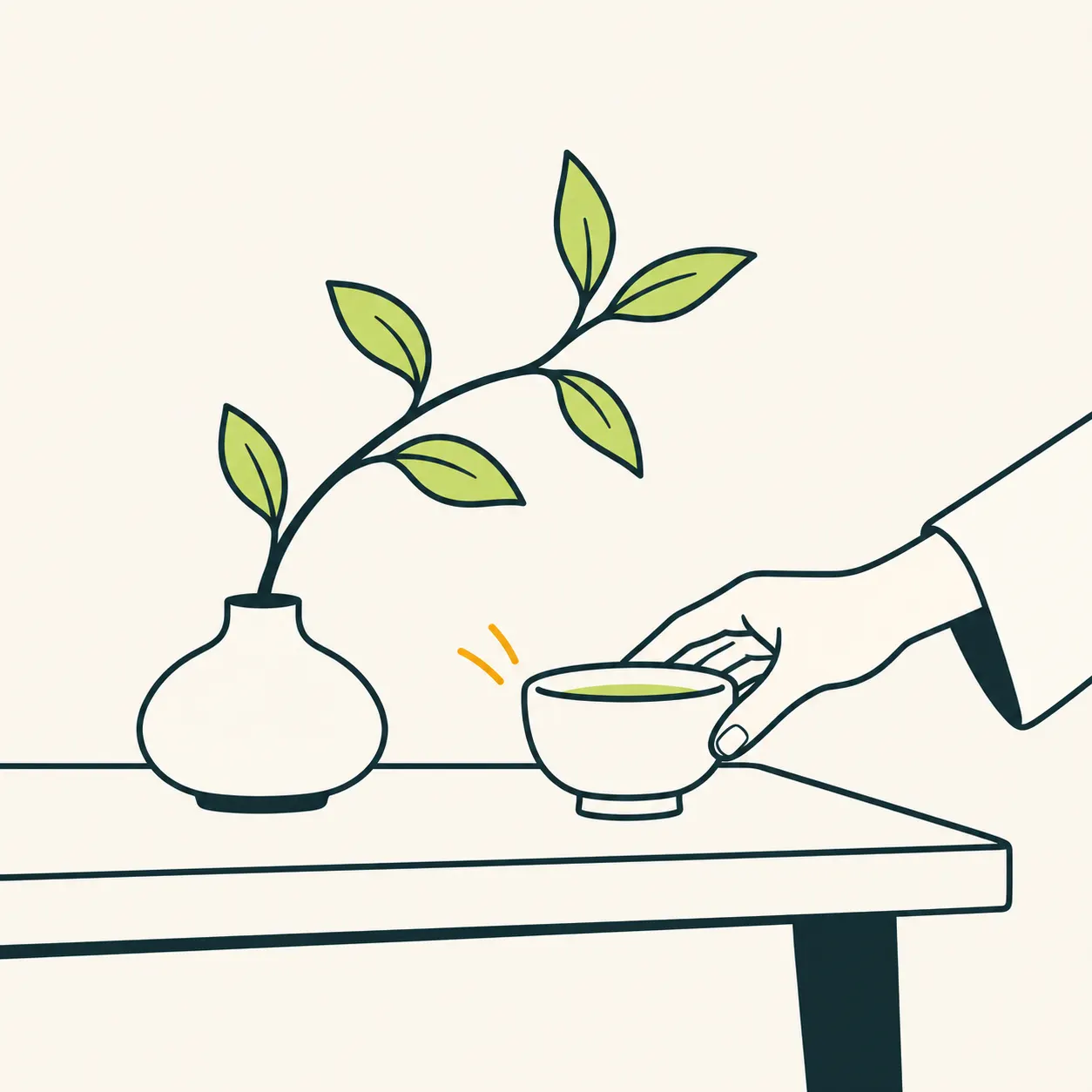
A cup on a table seems a modest starting point for thinking about life. Kakuzō Okakura takes it seriously in The Book of Tea, published in the United States in 1906 and written directly in English. Tokyo University of the Arts notes that it was originally addressed to readers outside Japan. This is an essay in cultural and aesthetic interpretation: its author builds a conversation through tea, rather than a scientific handbook of wellbeing. [2]
Chapter III, devoted to Taoism and Zen, contains the sentence: “The art of life lies in a constant readjustment to our surroundings.” These are Okakura’s words, not an anonymous proverb or a quotation that should automatically be attributed to Laozi. In his argument, attending to the present involves relating individual parts to a larger whole. The sentence belongs to that discussion, rather than standing alone as a promise of success. [1]
The interesting detail is constant: an arrangement that worked yesterday may not serve the same purpose today. In his chapter on the tea room, Okakura stresses the relationship between surroundings, taste and occasion. Our reading is that an order need not become a frozen model. A room can be carefully arranged precisely because it responds to its occupants, instead of asking everyone to fit an ideal photograph of it. [1]
Consider an editorial example, not a story from the book: a guest and a notebook arrive at the table. Moving the cup can make room without throwing everything away. The small action gives a concrete form to the difference between attention and routine. It does not prove a psychological theory; it simply allows us to ask a useful question. Am I maintaining this arrangement because it still works, or because I have stopped really noticing it? [1]
The historical context also matters. Okakura often discusses East and West through broad claims shaped by his cultural project. We should not treat these formulations as complete descriptions of present-day populations, traditions or individuals. Nor does the sentence tell us to accept every unjust circumstance. The invitation we choose to discuss is narrower: observe a concrete situation, distinguish what can be changed and respond to it with care. [1]
The book begins with tea but expands its attention to art and rooms. The discovery to take away is neither a compulsory furnishing scheme nor an abbreviated ceremony. It is a question about habit and presence. In our illustration, a hand moves a cup: this is a symbolic editorial image, not a reconstruction of a ritual. Even the tidiest table, after all, cannot decide on our behalf who needs a little space. [1][2]
Take this with youChoose a nearby object: does its position still support what you are doing, or does it simply follow a habit?
One idea, in simple words
Kakuzō Okakura wrote The Book of Tea in English. Published in 1906, it introduced aspects of Japanese culture to readers in other countries. For Okakura, even a cup could help us think about how we live. In chapter III, he says that the art of life lies in constantly readjusting to our surroundings. This is his thinking, not a scientific rule. Imagine a table with a cup and a notebook: if a friend arrives, you can move something to make room. This is our own example to help explain the sentence. Here, adapting means noticing the situation and choosing a response. It does not mean that every change is good or that we must accept everything without discussion. [2][1]
A little discovery to keep
What did you discover?
Read the sources (2)
- The Book of Tea, chapters II–IV (1906) Kakuzō Okakura · Project Gutenberg · accessed 24 Oct 2026
- The Book of Tea by Okakura Kakuzō Tokyo University of the Arts · GEICHA · accessed 24 Oct 2026
Original writing and illustration made with AI assistance. Our editorial method
More in Philosophy