Easy
How to care for it, step by step
Care guide checked on
Is it for you?
It is grown in a pot as a houseplant and can also be placed in a hanging basket. Give it a bright, sheltered position. [1][2]
Where to put it
Choose bright filtered or indirect light and protect the plant from direct afternoon sun. [1][2]
When and how to water
Keep the growing medium lightly moist without saturating it; let the surface dry slightly before watering, and water less often in winter. [3][1]
Pot and growing medium
Use a pot with drainage and a peat-free, loam-based potting mix that remains moist but lets excess water escape. [2]
Step by step
Place it in indirect light and notice whether its leaves retain their purple colouring. [1]
Check the surface of the growing medium: when it has dried slightly, water without leaving the soil saturated. [3]
For a compact shape, pinch out shoot tips; otherwise let the stems trail or provide a support. [2][1]
Periodically check leaves and stems for possible aphids, scale insects or mites. [1]
If something looks wrong
Leaves appear greener
Check
Check for insufficient light: NC State associates it with a greener appearance. [1]
What to do
Gradually move the plant to bright indirect light, protected from afternoon sun. [1]
Soil remains waterlogged
Check
Check the moisture of the growing medium and whether water can drain from the pot. [1][2]
What to do
Reduce excess water and ensure the medium drains; one symptom alone does not identify a disease. [1][2]
Very elongated stems
Check
Look at shoot length and the amount of light available. [1][2]
What to do
For a more compact shape you can pinch the tips and check that the light is adequate. [1][2]
Read the sources (3)
- Gynura aurantiaca · Velvet Plant NC State Extension Gardener Plant Toolbox · accessed 17 Oct 2026
- Gynura aurantiaca · purple velvet plant Royal Horticultural Society · accessed 17 Oct 2026
- Cultural Guidelines for Commercial Production of Purple Passion Plant University of Florida IFAS Extension · accessed 17 Oct 2026
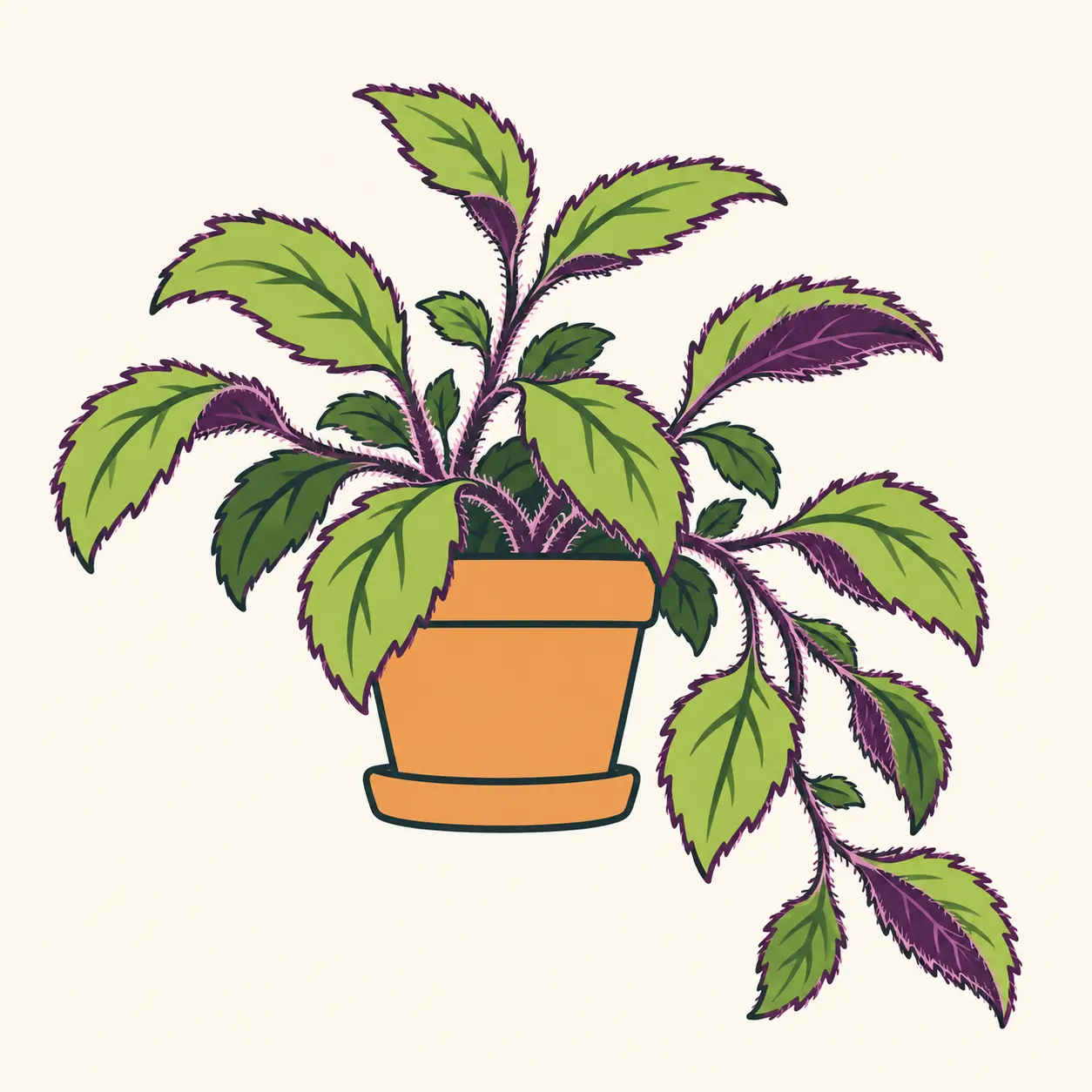
From a distance, it looks as if someone has drawn a purple veil over the leaves. Move closer and the surprise changes scale: Gynura aurantiaca has green leaves covered in short reddish-purple hairs. The stems have this covering too. North Carolina State University describes oval leaves with toothed margins; the University of Florida links the plant’s velvety appearance to those hairs. The purple is not fabric resting on the plant: it is part of its surface. [1][4]
The scientific name helps keep different subjects apart. Kew recognises Gynura aurantiaca in the Asteraceae family and places its native range from Sumatra to Java and Sulawesi, in the wet tropics. A plant in a pot is a cultivated individual, though: its place in a living room is not enough to reconstruct the landscape where the species grows in the wild. Name, family and distribution are different clues, not interchangeable photographs. [3]
The leaves are not the only detail worth noticing. The Royal Horticultural Society describes flower heads with yellow, orange or red discs, without the ray florets that give many daisies their radiating appearance. NC State notes small yellow-orange flowers and says they may not appear in low light. A plant with no visible flowers at a particular moment is therefore not automatically ill. Flowering is one observation among several, not a verdict. [2][1]
The strength of the purple can change too. According to NC State, bright indirect light and protection from afternoon sun encourage foliage colour; with insufficient light, leaves may look greener. This is not a precise diagnostic scale: one colour cannot tell the plant’s whole story on its own. It is more useful to compare conditions and growth over time than to try to force an immediate transformation. [1][2]
Stems may grow upwards or trail and lean against objects. The RHS suggests a support or pinching out shoot tips to encourage a more compact shape; NC State also presents the plant in hanging baskets. These are different ways to accommodate the same species, not evidence that every individual must have an identical form. The space available can help a grower decide which arrangement suits a particular plant. [1][2]
Care calls for another balance: moist does not mean saturated. NC State recommends less frequent watering in winter and warns that excess water can lead to rot. In its guidance for indoor use, the University of Florida suggests letting the surface dry slightly before watering. The RHS specifies a well-drained growing medium. Looking at both soil and pot is more useful than assigning water a fixed day on the calendar. [4][1]
As a small editorial exercise, look at a leaf from above, then gently inspect its underside without removing it. Notice the toothed edge, the shape of the blade and the hairs: the RHS notes purple hairs especially underneath. An illustration can make these features easier to see, but it cannot replace observing a real individual, which may look different with age, light or growing conditions. [1][2]
Take this with youNext time a colour looks uniform, try changing your distance: a surface can tell you more than it reveals at first glance.
One idea, in simple words
Gynura aurantiaca is a plant that many people grow indoors. From a distance its leaves look purple, but a detail lies beneath that colour: the leaves are green and covered in many tiny reddish-purple hairs. The stems are hairy too. The leaves are oval and have small teeth along their edges. The plant can produce yellow-orange flowers, although these are not always visible. It needs bright indirect light and moist soil that lets excess water escape. Too much water can make the roots rot; it needs less frequent watering in winter. As an editorial activity, look at a leaf without pulling it off and draw its edge. You may notice details that are hard to see from far away. [1][4]
A little discovery to keep
What did you discover?
Read the sources (4)
- Gynura aurantiaca · Velvet Plant NC State Extension Gardener Plant Toolbox · accessed 17 Oct 2026
- Gynura aurantiaca · purple velvet plant Royal Horticultural Society · accessed 17 Oct 2026
- Gynura aurantiaca (Blume) DC. Royal Botanic Gardens, Kew · Plants of the World Online · accessed 17 Oct 2026
- Cultural Guidelines for Commercial Production of Purple Passion Plant University of Florida IFAS Extension · accessed 17 Oct 2026
Original writing and illustration made with AI assistance. Our editorial method
More in Plants