Needs attention
How to care for it, step by step
Care guide checked on
Is it for you?
Suitable for someone able to check pot moisture and provide indirect light; flowering indoors is unlikely. [1][2]
Where to put it
Choose bright indirect light, avoiding intense direct sun and cold. A temperate room is preferable to a frost-exposed outdoor position. [1][2]
Step by step
If something looks wrong
Falling leaves and dry mixture
Check
Check whether the mixture really is dry; NC State also links leaf drop with dryness. [1][2]
What to do
If dry, water and let the excess drain; do not compensate by leaving the pot immersed. [1][2]
A constantly wet pot
Check
Check whether excess water remains in the outer pot and whether drainage holes are blocked. [1][2]
What to do
Remove standing water and restore drainage; if stems or roots seem damaged, ask a nursery for an assessment before further action. [1][2]
Read the sources (2)
- Pachira aquatica Royal Horticultural Society · accessed 27 Oct 2026
- Pachira aquatica: Extension Gardener Plant Toolbox North Carolina State University Extension · accessed 27 Oct 2026
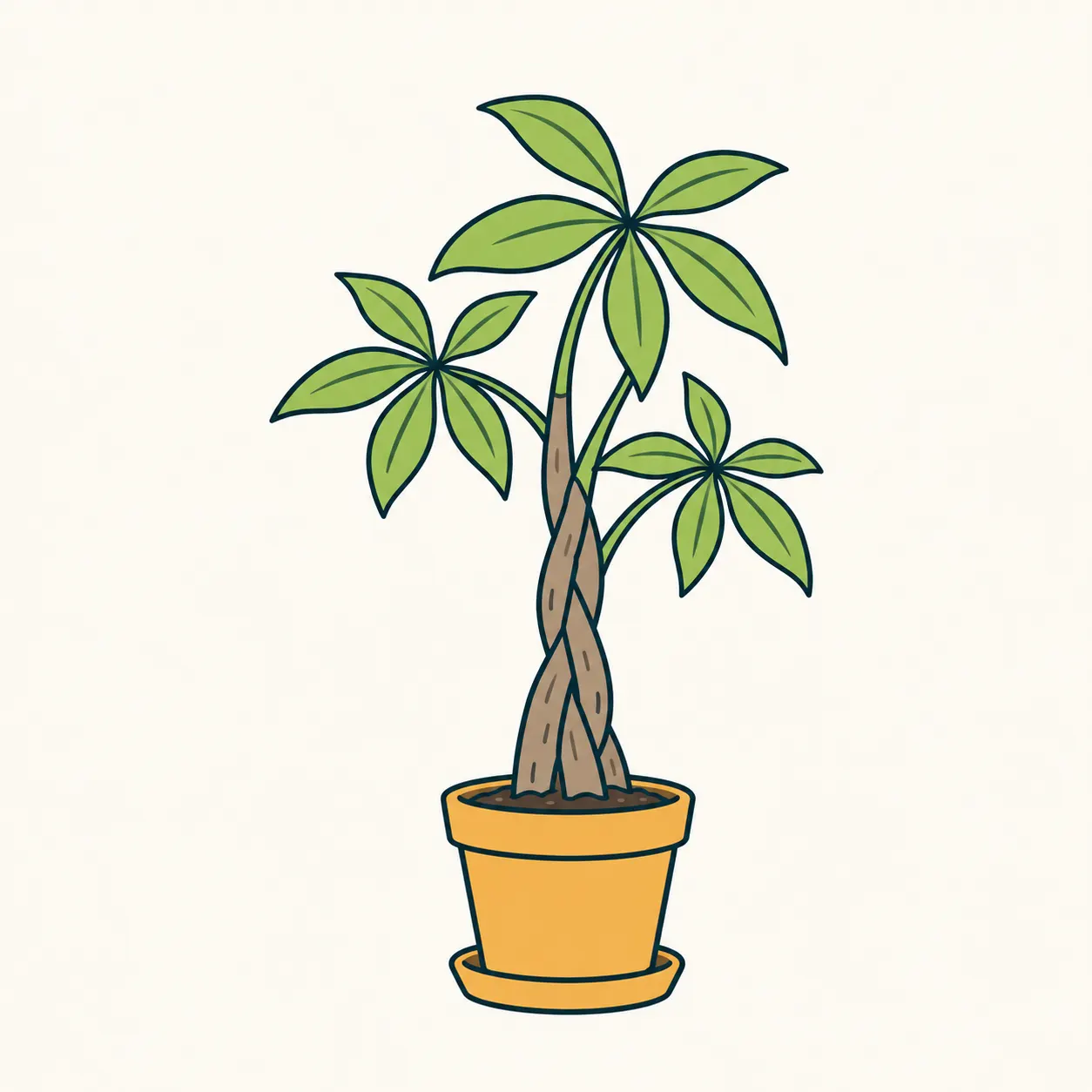
In an indoor pot, a Pachira can look like a tree that has learned to braid its hair. The braid, however, is not its spontaneous way of growing. The Royal Horticultural Society describes Pachira aquatica as an evergreen tree often sold with several plants plaited together. What looks like a single decorative trunk can therefore be a small group. Its commercial form records a human intervention, rather than a compulsory feature of the species or a pattern every individual follows. [1]
To recognise another part of its structure, look at one complete leaf. It is palmately compound: several leaflets spread from a common point, a little like open fingers. The North Carolina State University profile gives a range of five to nine. These are not that many independent leaves attached directly to the trunk. Following the leaf stalk to the meeting point helps explain the whole arrangement. A small difference in observation changes what, exactly, we are counting. [2]
The same profile places the plant in tropical American environments, including wetlands and riverbanks. This does not mean its pot should stand in water. Container-grown roots need a moist but free-draining mixture; standing water can encourage rot. Even the name aquatica is not a watering manual. The circumstances of a plant in its habitat and those of a pot in a living room cannot simply be equated without considering space, growing medium and the surrounding conditions. [2]
Imagine a small editorial exercise with two specimens: one braided, the other with a simple stem. If their leaves have the same organisation, the most striking difference may concern how they were cultivated. This example encourages closer attention, rather than replacing botanical identification. A display shape can attract attention while concealing the underlying plant structure. Separating those things lets us appreciate a grower’s work without attributing it to nature as a universal rule. Presentation and identity answer different questions. [1][2]
For indoor life, the sources recommend indirect light and a growing medium that allows excess water to drain. They do not promise that a houseplant will look like a large tropical tree: flowering indoors is unlikely. Before expecting spectacular effects, it makes sense to observe the leaves, moisture and actual growth. The braid remains a curious detail, but caring concerns living organisms. A plant does not have to deliver a plot twist every week to deserve a careful look. [1][2]
Take this with youFollow a leaf with your eyes to its stalk and then the stem. Count the observed parts without confusing a cultivated braid with botanical identity.
One idea, in simple words
Pachira aquatica is a tree that is also grown in pots. It sometimes has a braid of trunks: these are several young plants braided by a grower, rather than a braid the species makes by itself. Its leaves are compound. This means one complete leaf is divided into several leaflets joined at a common point. Imagine an open hand: the comparison helps show the arrangement, but a leaf is not really a hand. Indoors, Pachira needs indirect light and a growing mixture that lets excess water drain. The name aquatica does not mean leaving the pot in water. Watching the plant and its soil is more useful than always watering on the same day. [1][2]
A little discovery to keep
What did you discover?
Read the sources (2)
- Pachira aquatica Royal Horticultural Society · accessed 27 Oct 2026
- Pachira aquatica: Extension Gardener Plant Toolbox North Carolina State University Extension · accessed 27 Oct 2026
Original writing and illustration made with AI assistance. Our editorial method
More in Plants