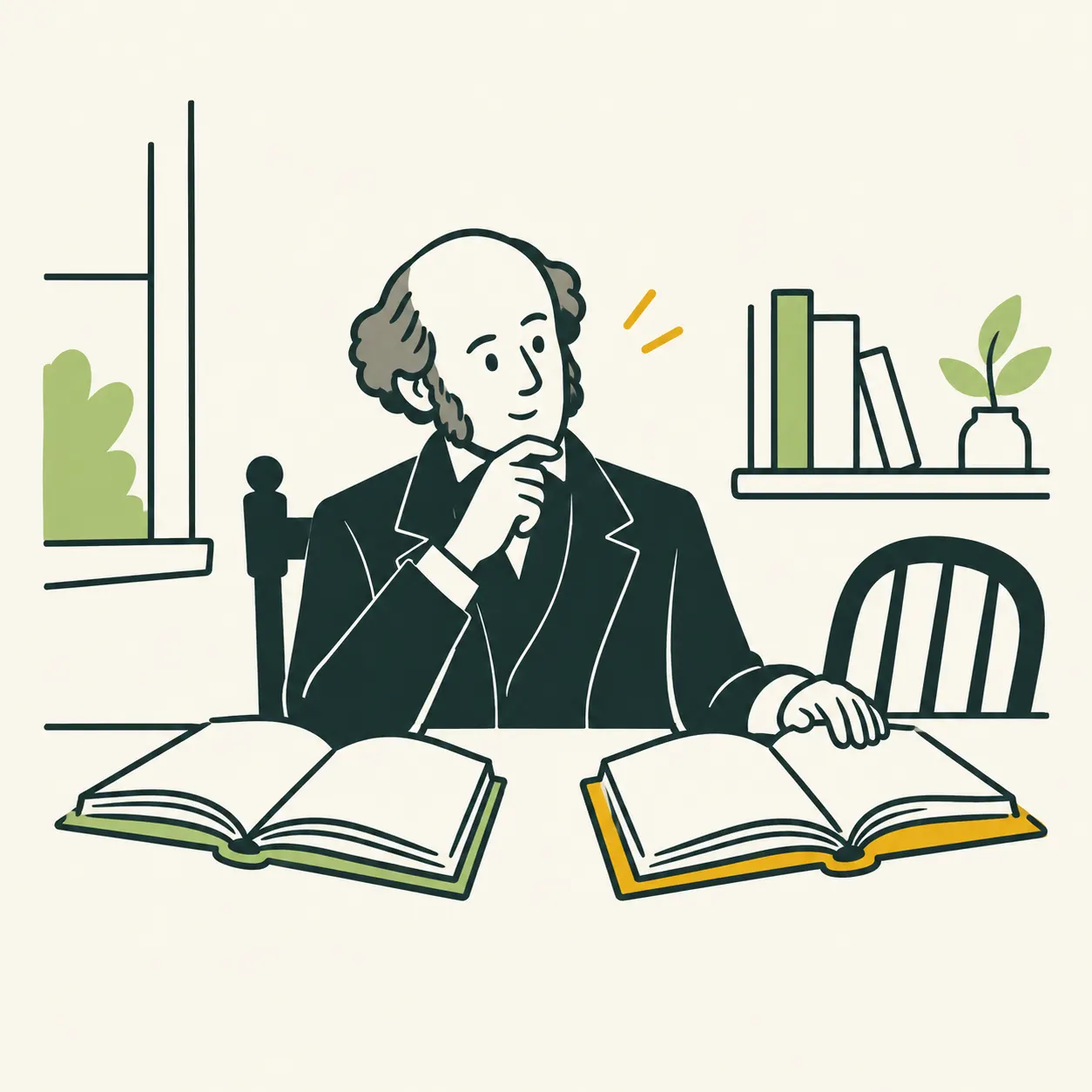
“He who knows only his own side of the case, knows little of that.” John Stuart Mill writes this sentence in the second chapter of On Liberty, published in 1859. This is the original English; the Italian and French versions are editorial translations. He is not asking us to change our minds merely to be polite. His harder question concerns what makes the position we already support reasonable, or vulnerable. [1]
A British philosopher who lived from 1806 to 1873, Mill worked on ethics, logic and politics and took part in public life. The Stanford Encyclopedia of Philosophy places his defence of freedom within a system of arguments, rather than presenting it as unlimited permission. We focus on one question within that project: what separates repeating a belief from understanding the reasons we have for thinking it is true? [2]
In the selected passage, Mill distinguishes an understood truth from a formula preserved through habit. Even a correct opinion can be poorly held if we cannot answer familiar objections. Discussion therefore does more than uncover mistakes: it can make a belief more conscious when it survives examination. His claim does not make the number of opponents a measure of truth, or require every disagreement to end in an exact draw. [1]
Mill adds a precise demand: hearing an opponent’s position only as their enemies describe it is not enough. We need to encounter reasons as a serious supporter would present them. Turned into an editorial exercise, this means stating an objection without making it ridiculous before the conversation begins. We can still reject it, but should explain which part fails instead of automatically assigning ignorance or bad intentions to its defender. [1]
Imagine a library deciding whether to extend its evening opening: this example is invented by our editors. One person thinks about students; another considers staff shifts. Before voting, each tries to describe the other’s constraint recognisably. That does not settle the budget, but it clarifies which information is missing. It is our contemporary application of Mill’s problem, not an incident in the book or a promise that agreement will follow. [1]
There is a practical limit: listening does not require treating every claim as equally well supported. This is our editorial caution when applying the passage. One piece of evidence may be strong while another is absent; a participant may refuse any examination. The useful exercise is still to ask which objection most seriously challenges our position, and which answer we can defend with checkable reasons. Every conversation need not become an endless contest. [1]
Take this with youBefore answering, restate the other person’s reason in a sentence they could recognise. Then identify your agreement and the points that need better evidence.
One idea, in simple words
John Stuart Mill was a philosopher: he studied questions about our ideas and how we live together. In On Liberty, he says that knowing only your own side of a question is not enough. An objection is a reason that challenges what we think. Listening carefully to it can help us understand our own idea better too. [1]
Here is an example invented by our editors. You want the library to open longer; someone else points out that its staff need workable shifts. Before answering, try explaining that reason without making fun of it. Then ask which information would help everyone decide. Listening does not mean agreeing with everybody: we can compare the evidence and explain why one proposal seems stronger than another. [1]
A little discovery to keep
What did you discover?
Read the sources (2)
- On Liberty · Chapter II: Of the Liberty of Thought and Discussion John Stuart Mill · Project Gutenberg · accessed 10 Oct 2026
- Mill’s Moral and Political Philosophy Stanford Encyclopedia of Philosophy · accessed 10 Oct 2026
Original writing and illustration made with AI assistance. Our editorial method
More in Philosophy