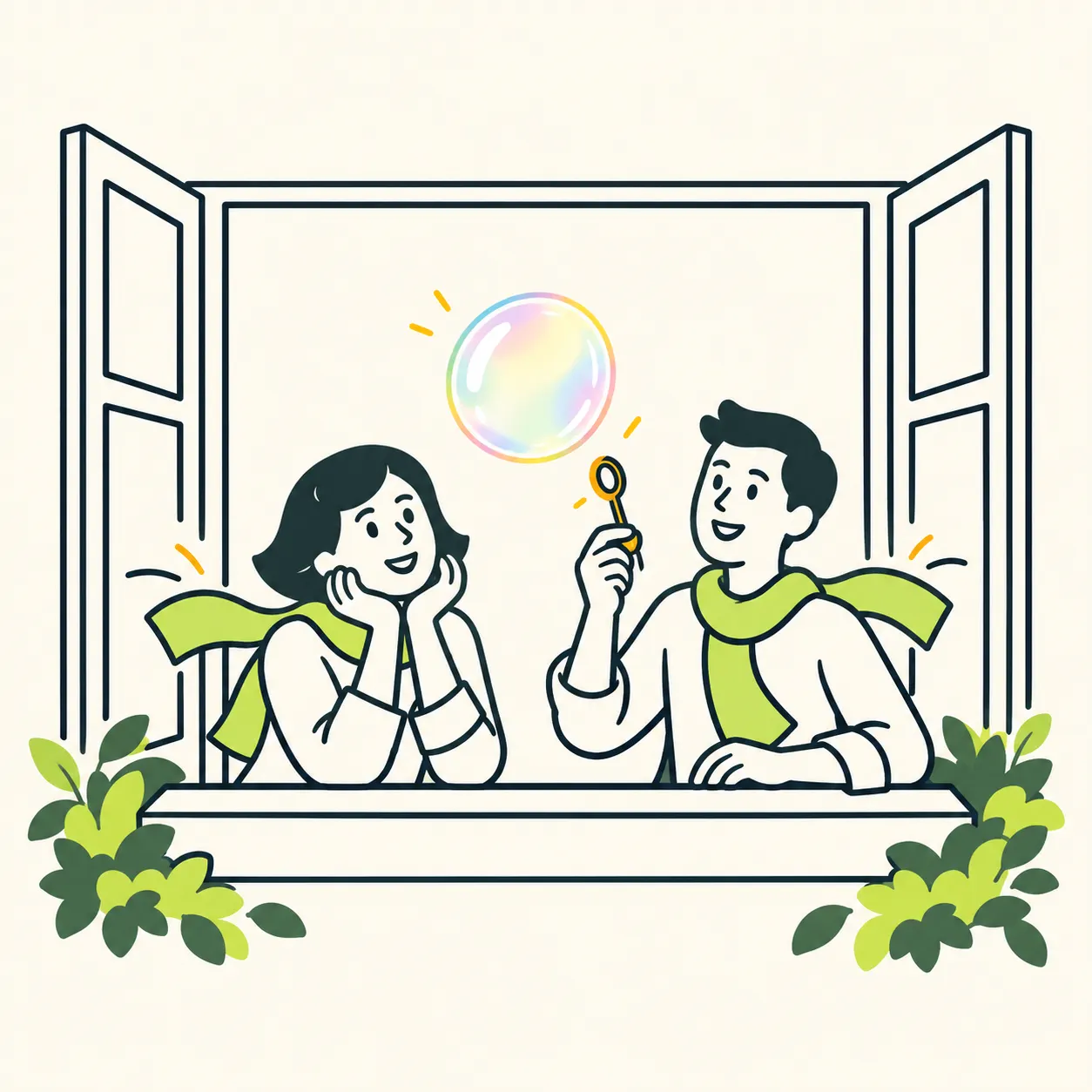
A bubble drifts across the room and, for a moment, pink, green or blue bands appear on its surface. Where were those colours hiding before the breath that made it? The film is not a painted palette: it is a thin layer of soapy solution through which light travels. In a University of Iowa demonstration, a bubble also shows an interference pattern similar to one produced by a film stretched across a ring. [1]
The surprising detail involves two reflections very close together. Some light returns from the film’s outer surface; some is reflected from the inner surface after passing through the liquid. When the light waves overlap, they can reinforce or weaken one another. This effect is called interference. Different components of light do not all respond in the same way, so the mixture reaching the eye can look coloured even when no coloured pigment has been added to the surface. [2][3]
To study the effect slowly, laboratories in Colorado and Santa Barbara project light reflected from a film held on a support. In their experiment, gravity draws liquid down and the film’s thickness changes; the observed bands change over time too. Iowa explains that a free bubble is harder to observe and project. The supported film helps demonstrate the principle, but it is not a recording of every bubble floating through a room. [3][2][1]
Position matters as well. In a University of Toronto model designed to represent bubbles and compare them with photographs, the viewing angle changes light’s path through the film and contributes to the colours seen. Purdue also shows that white light produces coloured bands, while a monochromatic source produces light and dark bands. A colour observed on a bubble is therefore not a universal label that, on its own, reveals the film’s exact thickness. [4][5]
Colours can still offer clues for a measurement. In a student project presented at Loyola University Chicago in 2026, Babel Barm and James Knott recorded a film with a camera and measured reflected green light with a sensor. They observed variations consistent with interference, but noise, air currents and limits of the equipment made precise thickness values difficult to calculate. This is a limited result, not a ready-made ruler for any bubble. [6]
As an editorial invitation, watch a bubble near a window next time and shift your viewpoint slightly. Which areas appear brighter? Do the colours remain still or change before the bubble disappears? There is no need to assign a number to every shade: you are observing light together with a changing surface. Our illustration is an imagined scene, not a photograph of the university experiment. [1][4]
Take this with youEditorial prompt: something transparent can change the light we see. Separate the colour you notice from a measurement that would require instruments.
One idea, in simple words
A soap bubble can show pink, green or blue bands. It is not painted: light meets its film, a very thin layer of soapy solution. Some light reflects from the outer surface and some from the inner one. When the light waves meet, some reinforce and others weaken one another. This effect is called interference, and it can make colours appear. In a laboratory, people can also observe a film stretched across a ring: its bands change as liquid runs down and its thickness changes. The light and where you stand matter too. For example, watch a bubble near a window and move a little. Its colour is a clue, not an exact measurement of thickness. [2][3][4][1]
A little discovery to keep
What did you discover?
Read the sources (6)
- Thin Film Interference — Soap Films University of Iowa · Department of Physics and Astronomy · accessed 17 Oct 2026
- Soap film interference University of California, Santa Barbara · Physics Lecture Demonstrations · accessed 17 Oct 2026
- Interference in a Soap Film University of Colorado Boulder · Physics Undergraduate Labs · accessed 17 Oct 2026
- Capturing the Reflectance Model of Soap Bubbles University of Toronto · Nigel Morris · accessed 17 Oct 2026
- Color in Thin Films Purdue University · Department of Physics and Astronomy · accessed 17 Oct 2026
- Interference Colors to Thickness: Measuring Thin-Film Dynamics with a Camera and Arduino Loyola University Chicago · Babel Barm and James Knott · accessed 17 Oct 2026
Original writing and illustration made with AI assistance. Our editorial method
More in Curiosities